
PEREGRINA87.08M Platform Supply Vessel
Main Features
Flag : Mexico
Harbor : Seybaplaya, Campeche
Arrival date to Mexico : December 2019
+ more information
Flag : Mexico
Harbor : Seybaplaya, Campeche
Arrival date to Mexico : December 2019
+ more information

Flag : México
Harbor : Tampico, Tamaulipas
Arrival date to Mexico : May 2020
+ more information


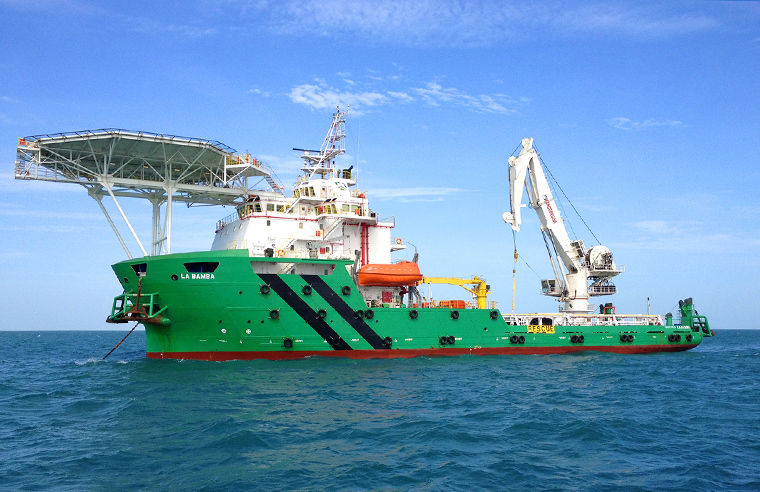
Flag : Mexico
Harbor : Isla del Carmen, Mexico
Arrival date to Mexico : June 21 2014
+ more information
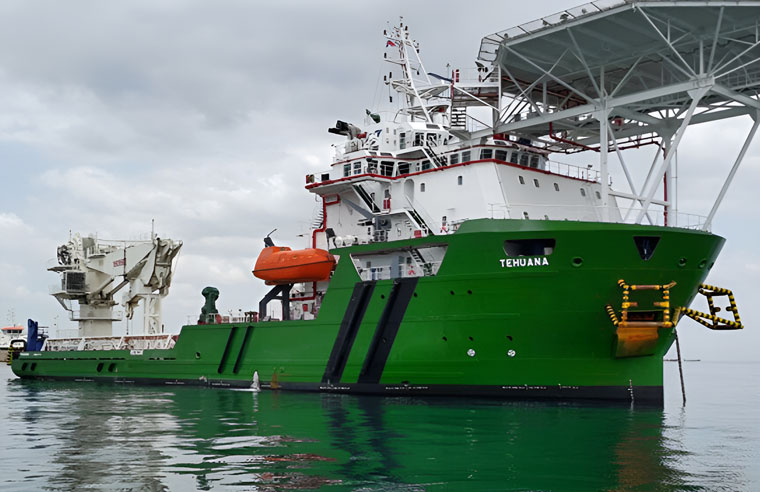
Flag : Mexico
Harbor : Isla del Carmen, Mexico
Arrival date to Mexico : March 5 2016
+ more information


Type: Self-elevating (jack-up) drilling unit for shallow-water operations.
Design: Marathon LeTourneau Class 116-C, 477 ft legs.
Operational water depth: up to 350 ft (≈ 107 m).
Drilling capacity: up to 25,000–30,000 ft (≈ 7,600–9,100 m).
Length overall: 74.09 m · Breadth: 61.11 m.
Built: 1981, Marathon LeTourneau, Brownsville, Texas, USA.
Flag: Mexico · Home port: Ciudad del Carmen, Campeche.
Classification: Standard jack-up for shallow-water offshore operations.

Sandunga is a self-elevating unit based on the Marathon LeTourneau 116-C design, with three wedged steel legs measuring 477 ft in length, enabling operations in water depths of up to 350 ft under typical Gulf of Mexico conditions. The rectangular hull provides a stable and safe working platform for shallow-water drilling operations.
The unit is equipped with a high-capacity jacking system that elevates the hull above sea level once positioned on location, ensuring structural stability against waves, currents, and wind, and meeting the requirements of maritime authorities and the offshore oil and gas industry.


The Jack-up Sandunga features a cantilever and drilling substructure designed to work over existing production platforms and fixed structures, allowing precise positioning of the drilling package over the well to be drilled or serviced.
Its drilling package is configured to reach a total measured depth of up to 25,000–30,000 ft, with capability to operate various mud programs, solids control systems, and surface pressure-control equipment in accordance with international safety standards.
The deck layout facilitates handling of drill pipe, casing, and auxiliary equipment, with dedicated areas for bulk mud, cement, fuel, and drilling water storage, optimizing operational time and cargo-handling efficiency.

Sandunga is equipped with a helideck located on the superstructure, designed to receive helicopters commonly used in the Gulf of Mexico for personnel transport and light supplies. This enables efficient crew rotations and rapid response to operational needs or emergency situations.
The helideck is supported by communication, navigation, and monitoring systems that enhance safety for air and marine operations, as well as waiting and coordination areas for boarding and disembarking personnel.
The Jack-up Sandunga is equipped with tanks for drilling mud, bulk cement, drilling water, potable water, and diesel, with pumping and transfer systems sized to support continuous drilling and workover campaigns. Deck cranes and lifting equipment enable safe handling of heavy equipment and materials.
Well-control systems include blowout preventers and manifolds designed to operate at working pressures suitable for the depth ranges of fields in the Bay of Campeche, following offshore industry safety practices.


Sandunga’s operations are carried out under strict industrial safety, occupational health, and environmental protection guidelines, aligned with Energía Naviera and Finestra Energía policies, as well as applicable Mexican and international regulations for offshore hydrocarbons operations.
The unit is equipped with fire detection and suppression systems, emergency procedures, regular drills, spill response equipment, and continuous training programs for crew and specialized personnel working onboard.
